
One of the challenges in disciple-making is learning how to tell Bible stories in a way that is simple, clear, and easy for others to reproduce.
Over the years, I have used Discovery Groups among people with little or no Bible background in Southeast Asia, Mexico, and other cross-cultural settings. In those environments, long explanations and detailed outlines often create confusion rather than understanding.
People do not need a seminary education before they can begin sharing God’s Word.
They need a simple way to hear God’s story, understand it, remember it, and share it with others.
In our article on the God’s Good News: 7 Discovery Bible Story Lessons, we introduced a simple sequence of stories that traces God’s plan of redemption from Creation to Christ.
In our Come. Follow. Fish. Discovery Group Format, we explained how Discovery Groups help people come to Jesus, follow His Word, and become fishers of people.
This storytelling framework serves the Follow portion of that process by helping people understand, remember, and retell God’s Word.
Learning from StoryBrand
One tool that has helped me think about communication is Donald Miller’s StoryBrand framework.
StoryBrand identifies several key elements found in effective stories:
- Character
- Problem
- Guide
- Plan
- Call to Action
- Failure
- Success
I have found these principles helpful for ministry communication, including websites, newsletters, videos, sermons, fundraising, and ministry updates. StoryBrand helps clarify the message and identify what is at stake.
But in oral and cross-cultural settings, I need something even simpler and more reproducible.
A Simpler Framework for Bible Storytelling
In the Follow portion of the Come. Follow. Fish. Discovery Group format, we want people to hear, understand, remember, and retell God’s Word.
When telling Bible stories in Discovery Groups, we often reduce the story to four simple movements:
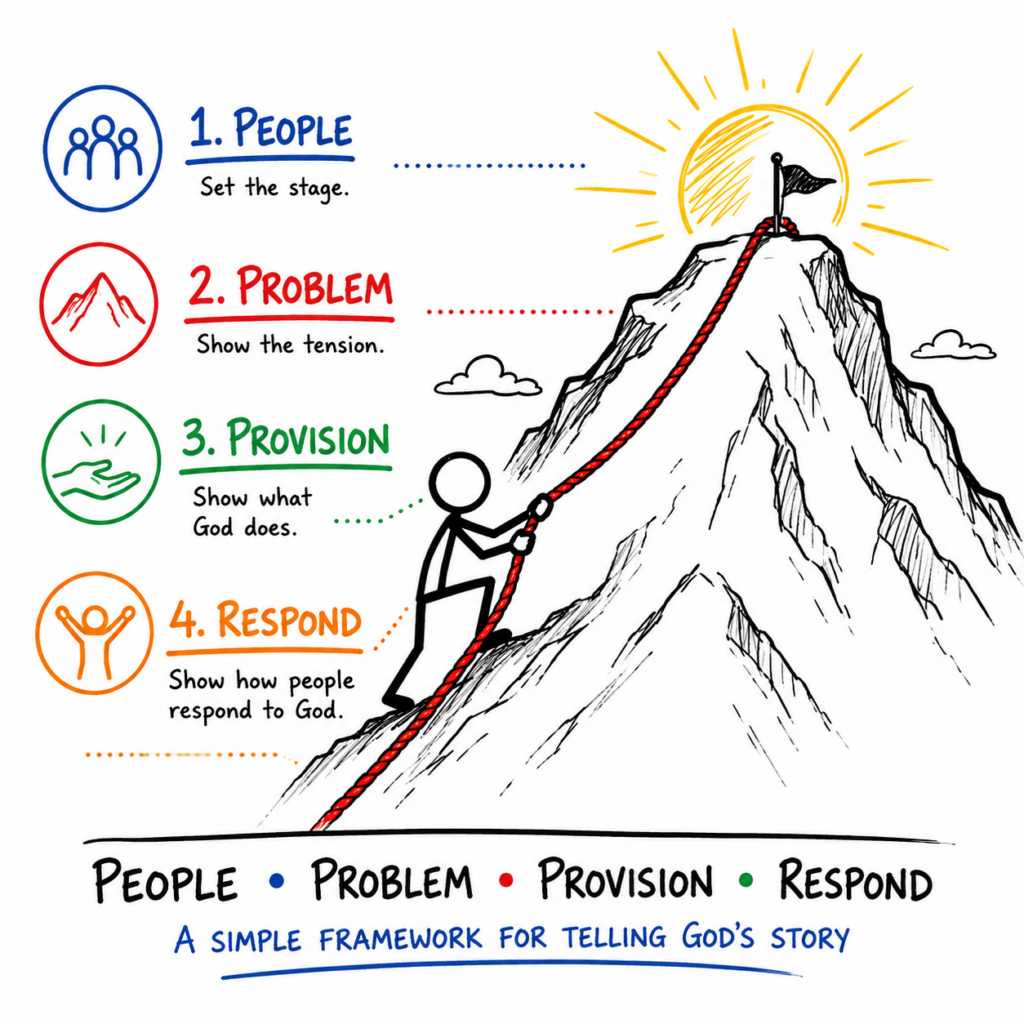
People • Problem • Provision • Respond
This simple framework helps others understand and retell the story.
In its simplest form:
People = set the stage.
Problem = show the tension.
Provision = show what God does.
Respond = show how people in the story respond to God.
Those four movements provide a simple pathway for understanding, remembering, and retelling almost any Bible story.
Learning the Story Before Telling It
Before using this framework, we first need to know the story well enough to tell it simply.
That does not mean memorizing every word.
It means hearing or reading the passage several times, understanding the flow of the story, and practicing how to tell it naturally in our own words while staying faithful to the Bible text.
A good Bible story should feel simple, clear, and alive.
Drawing the Story
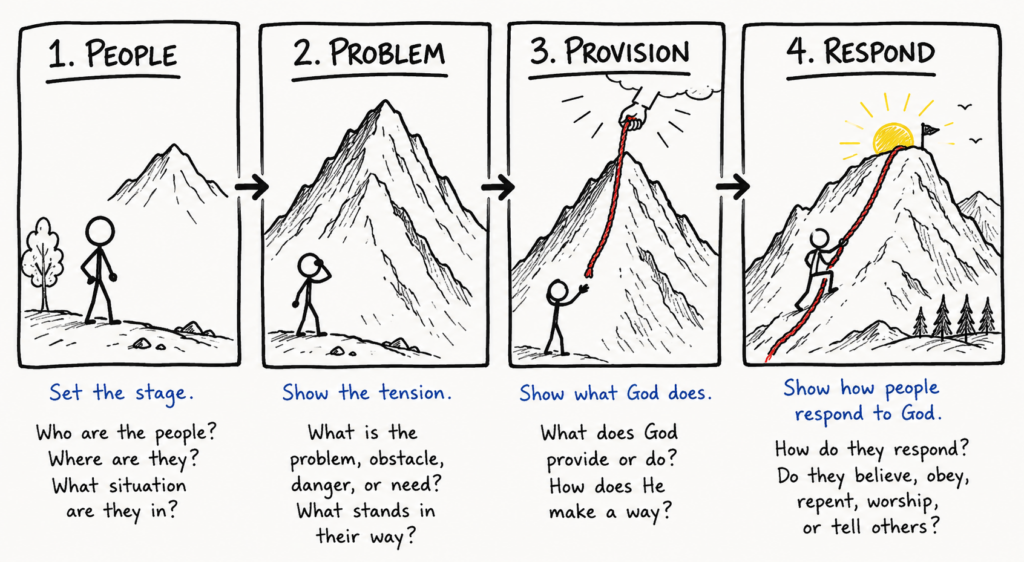
Sometimes we draw the story as we tell it.
Because the story moves through four simple movements—People • Problem • Provision • Respond—we can also draw it in four simple scenes.
The goal is not art.
The goal is memory.
Simple drawings help people see the story, remember the order, and retell it to someone else.
This is especially helpful in oral, cross-cultural, or low-literacy settings where people may remember images more easily than outlines.
Whether we tell the story with words, gestures, or simple drawings, the goal is the same:
Help people hear God’s Word, remember God’s Word, and share God’s Word with others.
People
Who are the people in the story?
Where are they?
What situation are they facing?
This is where we set the stage.
Stories are about real people in real places facing real situations. We do not need to stop and give a long background lesson. We simply give enough context so people can enter the story and understand what is happening.
For example, in the story of Zacchaeus, we might begin:
There was a man named Zacchaeus. He lived in Jericho and was a chief tax collector. He was rich, but the people hated him because tax collectors often cheated their own people. One day, Jesus was passing through Jericho, and Zacchaeus wanted to see Him.
In just a few sentences, we have introduced the person, the place, and the situation.
Problem
What is broken, missing, lost, threatened, or needed?
Every story contains tension.
Adam and Eve are separated from God because of sin.
Israel is enslaved in Egypt.
The Samaritan woman is spiritually thirsty.
Zacchaeus is wealthy, but he is lost, rejected, and separated from God.
Without a problem, there is no need for redemption.
Provision
What does God provide?
What does He reveal, command, promise, or do?
God provides a covering for Adam and Eve.
God provides the Passover lamb.
Jesus provides living water.
Jesus provides forgiveness through His death and resurrection.
Every Bible story ultimately points to God’s provision through Jesus Christ.
Respond
How do the people in the story respond to God?
Do they believe?
Do they obey?
Do they repent?
Do they worship?
Do they reject Him?
Do they tell others what He has done?
In this storytelling framework, Respond first helps us notice what happens inside the Bible story.
Adam and Eve hide from God.
Israel applies the blood of the Passover lamb.
The Samaritan woman leaves her water jar and tells others about Jesus.
Zacchaeus welcomes Jesus, repents, and makes restitution.
Later, during the Discovery Group discussion, we ask how we should respond to God’s Word in faith, obedience, surrender, and sharing.
But when we are telling the story, we first want to see how the people in the story respond to God.
God’s Word always invites a response.
An Example: Zacchaeus
People — Zacchaeus, Jesus, and the crowd.
Problem — Zacchaeus is separated from God and rejected by others.
Provision — Jesus seeks him, calls him by name, and offers fellowship and salvation.
Respond — Zacchaeus welcomes Jesus, repents, and his life is transformed.
Why This Framework Works
People • Problem • Provision • Respond helps people:
- Understand the flow of a Bible story
- Remember the story
- Retell it accurately
- Share it with others
- Respond in obedience
- Reproduce the story in new groups
Simple tools are often the most reproducible tools.
Can you retell this story in your own words?
This is so important and is often referred to as oral storytelling.
Practice Telling the Story
Read the Bible passage several times. Then practice retelling it in your own words using the People • Problem • Provision • Respond framework.
Additional Storytelling Resources
These resources already include many Bible stories:
And reproducible tools help make disciples who make disciples.
If you have not yet read them, I encourage you to start with the God’s Good News: 7 Discovery Bible Story Lessons and the Come. Follow. Fish. Discovery Group Format articles. Together, these simple tools provide a practical pathway for sharing God’s story, making disciples, and multiplying Discovery Groups.