
How We Developed the 7 God’s Good News Stories
For years, I have shared Christ with people who have little or no background in the Bible, especially among Unreached People Groups in Southeast Asia. In those settings, I have learned that people often do not need a sermon first. They often have simple questions like, “How was the world created?” and “Who were my first ancestors?”
They need to hear the story of the God who created them, loves them, seeks them, and has made a way for them to come back to Him.
That is why I use a discovery-type format instead of preaching. We tell a Bible story, ask the person or group to retell it, and then ask simple discovery questions that help them hear what God is saying through His Word.
Two of the most important questions we ask are:
How can I obey what I have learned?
Who can I share this story with?
We also emphasize accountability. When we meet again, we ask how it went. Did you obey what God showed you? Did you share the story with someone else?
This keeps the focus on obedience, multiplication, and living as ambassadors of Christ.
A couple of my favorite resources that shaped this approach are the Zúme Training website and the Train & Multiply lessons. Both emphasize simple, reproducible disciple-making that ordinary believers can immediately practice and pass on to others.
The Discovery Group Format

We use a simple format built around Jesus’ invitation in Matthew 4:19:
“Come, follow Me, and I will make you fishers of men.”

Come
We gather before God and one another through care, prayer, encouragement, and accountability.

Follow
We listen to Jesus through His Word. We hear the Bible story, retell it, and reflect on what God is teaching us.

Fish
We respond in obedience and identify who we will share the story with.
You can learn more here: Come. Follow. Fish: A Simple Discovery Group Format.
Bible Stories for Those Seeking Christ
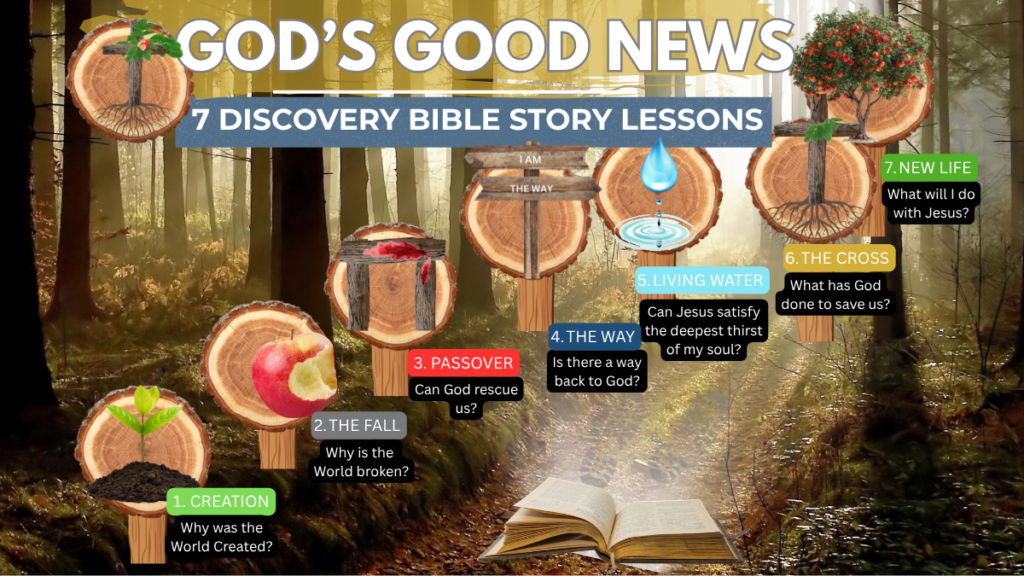
After years of using these stories and refining the flow, we developed a 7-story Good News path. These stories help people move from creation, to brokenness, to sacrifice, to redemption, to Jesus, to repentance and surrender.
Lesson 1 — Creation
Bible Story: Creation (Genesis 1–2)
Theme: God’s Perfect Kingdom
Question: How did creation begin?
Lesson 2 — The Fall
Bible Story: Covering and Cain & Abel (Genesis 3–4)
Theme: The Scarlet Thread begins
Question: Why is the world broken?
Lesson 3 — Passover
Bible Story: Exodus 12
Theme: Redemption through blood
Question: Can God rescue us?
Lesson 4 — The Way
Bible Story: John 14
Theme: Jesus is the way back to the Father
Question: Is there a way back to God?
Lesson 5 — Living Water
Bible Story: John 4:1–42
Theme: Jesus satisfies the deepest thirst of the soul
Question: Can Jesus satisfy the deepest thirst of my soul?
Lesson 6 — The Cross
Bible Story: Jesus’ ministry, death, and resurrection
Theme: Jesus is the sacrifice and risen Lord
Question: What has God done to save us?
Lesson 7 — New Life
Bible Story: Zacchaeus and Gospel Invitation
Theme: Repentance, surrender, and following Christ
Question: What will I do with Jesus?
The Biblical Threads Behind These Stories
These seven stories are built around several important biblical threads, including creation, fall, covenant, sacrifice and atonement, tree of life, Kingdom, mission to the nations, and new creation.
Together, they help people see that the Bible is not just a collection of separate stories. It is one unified story that leads to Jesus.
You can learn more about these themes here: The Biblical Threads Behind God’s Good News. (Coming soon)
How We Keep the Stories Simple
For the Bible story portion of the Discovery Group, we keep the storytelling simple and reproducible by using four movements:
People • Problem • Provision • Respond
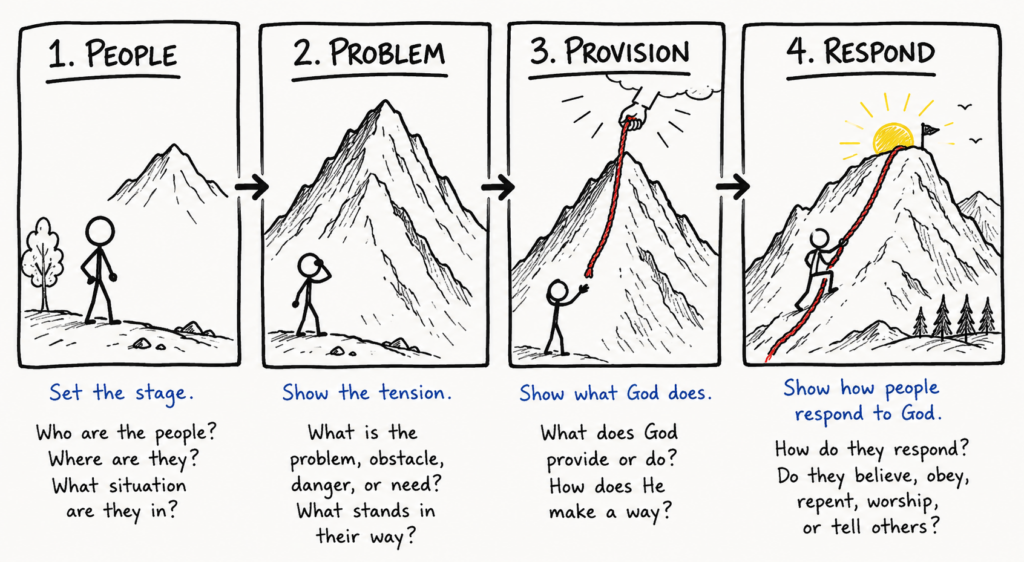
This is not a marketing formula. It is a simple Bible storytelling framework that helps people understand, remember, and retell God’s Word.
People — Who is in the story? Where are they? What situation are they facing?
Problem — What is broken, missing, lost, threatened, or needed?
Provision — What does God provide, reveal, command, promise, or do?
Respond — How do the people in the story respond to God?
Later, during the Discovery Group discussion, we ask how we should respond in faith, obedience, surrender, and sharing. But when we are telling the story, we first notice how the people in the story respond to God.
This helps ordinary believers tell Bible stories clearly without needing a sermon outline, long notes, or a complicated teaching method.
You can learn more here: Simple Bible Storytelling Framework: People • Problem • Provision • Respond.
From Good News to Obedient Discipleship
These Good News stories are not meant to end with a one-time decision or repeated prayer. They lead naturally to repentance, faith, surrender, baptism, obedience, and mission.
After someone responds to Jesus, we continue with the 7 Commands of Christ, which provide a simple path for new disciples to begin obeying Jesus. Baptism is included as a natural step of obedience after surrender.
You can learn more on this website: 7 Commands of Christ.
God’s Good News Leads to God’s Mission
God’s mission is to reconcile the world to Himself through Christ.
These stories help people hear that good news, respond to Jesus, and begin living as His ambassadors.
The goal is not only that people hear the Gospel.
The goal is that they follow Jesus, obey His Word, share His story, and help others follow Him too.